
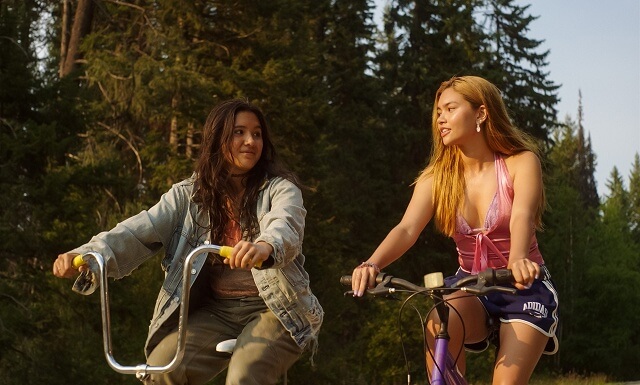
Girls Like Girls is a surprisingly moving coming-of-age romance that may not break particularly new ground in terms of its story, but succeeds largely because of the warmth and sincerity at its heart.
Based on Hayley Kiyoko's hugely popular 2015 song and music video, as well as her subsequent novel, the film follows 17-year-old Coley (Maya da Costa), who is struggling with the loss of her mother and finding her place in the world. During a summer in Oregon, she meets Sonya (Myra Molloy), and what begins as a friendship gradually develops into something more. For Coley, it becomes an unexpected first experience of love, attraction and vulnerability, while Sonya is forced to confront feelings she isn't quite prepared for.
On paper, there isn't necessarily anything revolutionary about the story. At its core, Girls Like Girls is a fairly familiar coming-of-age love story, following many of the conventions we've seen before: two young people meet, an attraction develops, obstacles emerge and the characters are forced to confront their feelings. In that respect, the film can occasionally feel quite generic.
What makes it work, however, is the emotional sincerity behind it. I found myself much more moved by the film than I expected to be. There is something particularly affecting about watching these characters experience the excitement, awkwardness and vulnerability of first love, and Hayley Kiyoko's direction gives the relationship enough space to develop naturally.
The two central performances are a major strength. Maya da Costa and Myra Molloy have wonderful chemistry together, making Coley and Sonya's relationship feel believable rather than simply something dictated by the screenplay. Their performances give the film much of its emotional weight, particularly in the quieter moments when very little needs to be said. Zach Braff and Levon Hawke also provide strong support in their respective roles.
Visually, Girls Like Girls is another highlight. The cinematography by Sonja Tsypin gives the film a warm, nostalgic quality that perfectly complements its coming-of-age themes. There is a lovely sense of summer throughout the film, and some scenes have an almost dreamlike quality that reflects the intensity of falling in love for the first time.
The musical soundtrack is equally effective. Given that the film originated from one of Kiyoko's songs, music was always going to be an important part of its identity, but it never feels as though the soundtrack is simply being used as decoration. Instead, it helps create the film's emotional atmosphere and adds considerably to its sense of youthful nostalgia.
It is also worth acknowledging what Hayley Kiyoko has achieved with the film. This is her feature directorial debut, and she has taken a story that began with a song and music video and expanded it into a feature-length coming-of-age romance.
Ultimately, Girls Like Girls isn't a film that reinvents the romantic drama. Its story is familiar and, at times, perhaps a little too predictable. But originality isn't everything, and there is enough heart, strong acting, beautiful cinematography and an evocative soundtrack here to make it an unexpectedly affecting experience.
Given its relatively poor US box-office performance, it would be a shame if the film were simply overlooked by audiences elsewhere. Girls Like Girls feels like the kind of modern