
Aaron Sorkin returns to the world of Facebook with The Social Reckoning, a loose follow-up to his far superior The Social Network. Sorkin wrote the original film, but this time he takes on both writing and directing duties, giving him even greater control over the material. The connection between the two films is fairly tenuous, however, making The Social Reckoning more of a spiritual follow-up than a conventional sequel. It tells its own story, focusing on what Facebook became rather than how it began, and can easily be enjoyed without having seen its predecessor.
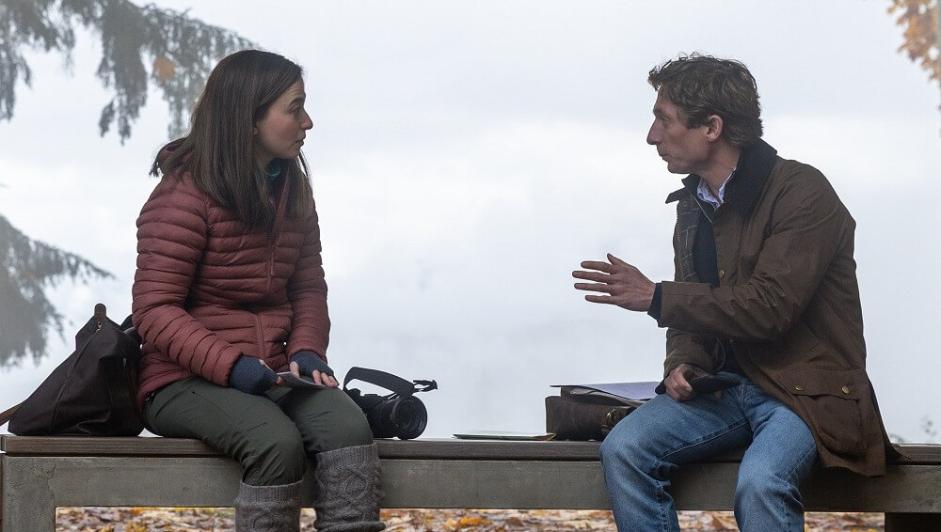
This time, Sorkin moves away from Facebook's creation and towards the damage it has allegedly helped unleash. The film centres on Frances Haugen (Mikey Madison), the Facebook engineer turned whistleblower, and Wall Street Journal journalist Jeff Horwitz (Jeremy Allen White), whose investigation brings her revelations into the public eye.
The story is based on real events that unfolded largely between 2018 and 2021. Haugen joined Facebook in 2019 and worked on its Civic Integrity team, which dealt with elections, misinformation and other threats to the platform. The film follows her growing concerns about what Facebook knew about the potential harm caused by its platform, and the increasingly difficult decision over whether to expose what she had discovered.
Their story unfolds like a modern-day Watergate, gradually exposing what Facebook knew about misinformation, political influence and the consequences of its own algorithms.
At the heart of the film's argument is the accusation that Facebook understood its platform could cause serious harm but repeatedly struggled to put that knowledge ahead of its own commercial interests. Its algorithms were designed to maximise engagement, keeping users clicking, sharing and returning to the platform, but the same system could also reward outrage, divisive content and misinformation because those things generated attention.
The film suggests that Facebook was aware of the problem through its own internal research, yet the pressure to maintain growth and engagement made meaningful action difficult. That is what gives the story its investigative quality: the question isn't simply whether Facebook caused harm, but how much the company knew about it and what it chose to do with that knowledge.
It's an effective approach. Rather than attempting to dramatise the entire history of social media, Sorkin gives the story a clear investigative spine and lets the revelations accumulate. At its best, the film captures the unnerving idea that Facebook's greatest scandal may not be any single decision, but the sheer scale of what the company knew about the consequences of its platform and chose to do — or not do — about them.
The political dimension makes the issue even more serious, as the film explores how misinformation and algorithm-driven division can influence public opinion and political debate on a scale far beyond the control of any individual user.
Madison and White are the film's biggest strengths. Both bring urgency and intelligence to what could easily have become a dry succession of conversations about algorithms and data. Their performances give the investigation a human centre, while Sorkin's trademark rapid-fire dialogue keeps things moving.
Jeremy Strong's casting as Mark Zuckerberg is intriguing, particularly after Jesse Eisenberg declined to reprise the role, but his presence is surprisingly limited. Given Strong's reputation and the importance of Zuckerberg to the story, it's an odd choice to give him so little screen time. When he does appear, the character can also feel overly simplified — less like the complicated head of a multibillion-dollar company and more like a convenient villain for the audience to hiss at. A more nuanced portrayal might have given the film another perspective on where corporate responsibility begins and ends, and made Zuckerberg's absence from the wider story feel less conspicuous.
However, that same approach can sometimes work against the film. The bigger problem is that Sorkin occasionally overwhelms his own story with the sheer amount of information he wants to convey. There is a relentless stream of discussion about algorithms, engagement, misinformation, data and political influence, and the rapid-fire dialogue can make the film difficult to follow. Sorkin clearly wants the audience to understand the machinery behind Facebook's influence, but explaining everything at speed isn't always the same as making it compelling. At times, the complexity feels less like drama and more like a lecture.
Even so, The Social Reckoning has plenty to say. Its strongest moments come when the investigation takes centre stage and the film treats Facebook less as a collection of technological innovations than as an institution whose decisions have consequences far beyond its own walls. The Watergate comparison may be obvious, but it gives the story a useful sense of scale: this isn't simply a story about a controversial company, but about what happens when an enormously powerful organisation is allowed to operate with comparatively little accountability.
The film's most uncomfortable suggestion is that the problem isn't necessarily that Facebook set out to damage society, but that its business model could make harmful consequences acceptable as long as the numbers continued to rise.
What it lacks is the spark of The Social Network. That film had sharper dialogue, more distinctive characters and a propulsive sense of conflict. Sorkin's latest is more earnest and arguably more important, but it is also less entertaining and considerably less memorable.
The Social Reckoning is an intelligent and occasionally gripping film, with strong performances from Madison and White and a genuinely compelling story at its centre. But Sorkin throws so much information at the audience that the human drama sometimes gets buried beneath the argument he is trying to make. The result is a film with plenty of relevance but not quite enough subtlety — a worthwhile examination of Facebook's power, but ultimately a pale shadow of the film that first made Sorkin's version of this world so compelling.
The Social Network made the birth of Facebook feel like a great American drama; The Social Reckoning makes its consequences feel like an important one, but not necessarily a great one.
The Social Reckoning
Director: Aaron SorkinCast: Mikey Madison, Jeremy Allen White, Wunmi Mosaku, Betty Gilpin, Billy Magnussen, with Bill Burr and Jeremy Strong
UK Release: Cinemas 9th October 2026