
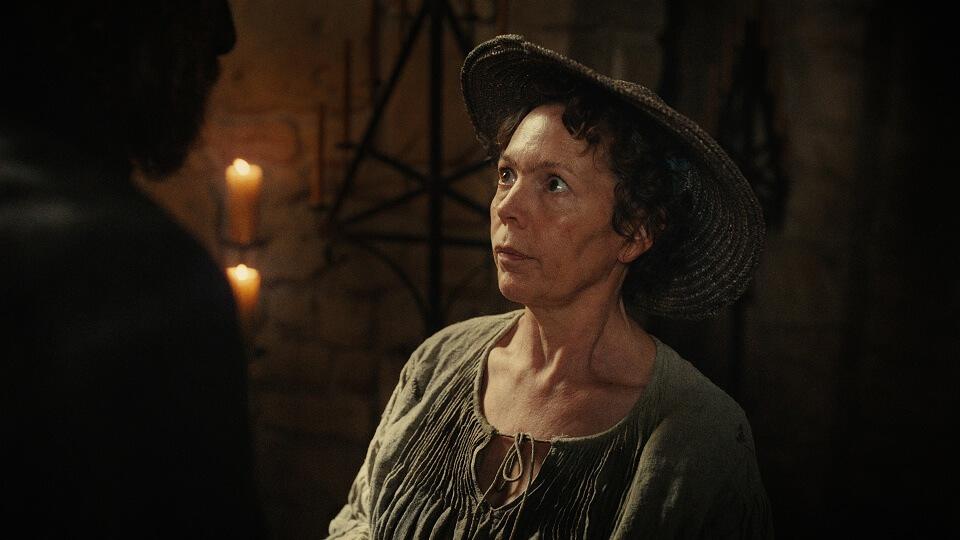
Based on the short story The Wicker Husband by Ursula Wills-Jones, Wicker is an unusual fantasy comedy that blends romance, dark humour and social satire. Written and directed by Alex Huston Fischer and Eleanor Wilson, whose previous collaboration was the 2020 science-fiction comedy Save Yourselves!, the film takes an eccentric premise and attempts to turn it into a modern fable about love, marriage and the expectations society places upon women.
Set in a small, seemingly timeless coastal village, the story follows an unmarried fisherwoman (Olivia Colman) who is shunned and ridiculed by the locals, not least because of the overpowering smell of fish that follows her everywhere. Tired of being treated as an outsider, she approaches the village basketmaker (Peter Dinklage) and commissions him to create a husband made entirely from wicker.
When her new husband (Alexander Skarsgård) comes to life, he proves to be everything she could have wished for: handsome, attentive, affectionate and remarkably gifted in the bedroom. However, their unconventional relationship soon becomes the talk of the village, attracting jealousy, resentment and suspicion from those whose own marriages are considerably less satisfying.
The film boasts an impressive cast, led by Academy Award winner Olivia Colman, whose previous work includes The Favourite, The Lost Daughter and Broadchurch. Alexander Skarsgård, known for The Northman, Big Little Lies and Succession, takes on the unusual role of the wicker husband, while Game of Thrones star Peter Dinklage plays his creator. Elizabeth Debicki, familiar from The Crown and Tenet, appears as the tailor's wife, with Richard E. Grant among the supporting cast.
On paper, the combination of such an accomplished cast and an imaginative premise should make for something rather special. Unfortunately, Wicker never quite manages to turn its intriguing concept into a particularly engaging film.
Perhaps part of the problem lies in the film's origins as a short story. What may have worked perfectly well as a brief, whimsical fable feels rather thin when stretched to feature length. Despite its 105-minute running time, the story rarely develops beyond its initial premise, with none of the characters given sufficient depth to make their actions or motivations particularly convincing.
This is especially disappointing given Colman's involvement. Despite being the film's biggest attraction, she is given surprisingly little to work with. For much of the running time, her character seems to do little more than go about her daily routine and enjoy an increasingly physical relationship with her wicker husband. An actress of Colman's considerable talent deserves more substantial material, but the screenplay rarely gives her an opportunity to demonstrate her abilities.
Skarsgård fares somewhat better, bringing an unexpectedly gentle quality to a character who could easily have become little more than a novelty. Dinklage also makes an impression as the basketmaker, although, like the rest of the supporting cast, his character feels underdeveloped. Even the villagers, whose jealousy and resentment are central to the story, are largely defined by their behaviour rather than any meaningful exploration of their personalities.
There is also the question of what Wicker is actually trying to say. Is it a story about feminism and female empowerment, challenging traditional expectations of marriage and a woman's place in society? Is it about greed, lust, envy or revenge? Perhaps it is intended to explore all of these themes, but the film never seems particularly interested in examining any of them in sufficient depth.
Fables generally work best when their simplicity helps communicate a recognisable moral or message. Here, however, the various themes compete for attention without any one of them emerging with much clarity. What begins as an intriguing tale of a woman refusing to conform gradually becomes a collection of increasingly strange situations that offer little emotional or intellectual reward.
There is certainly some imagination in the film's premise, and its deliberately peculiar mixture of romance, comedy and fantasy occasionally produces moments of amusement. Yet these are not enough to overcome the lack of character development or the feeling that the story is being stretched considerably further than its original material can comfortably support.
Ultimately, Wicker is a frustrating experience. With such an unusual concept, an accomplished cast and the potential to explore some interesting ideas about love, relationships and society, it should have been much more entertaining and thought-provoking than it turns out to be. Instead, its characters remain distant, its themes muddled and its story surprisingly slight.
In the end, Wicker is as cold as the wicker man's heart.